Wall charts, history and European Identity

Skip to content
EU Culture Programme; Education and Culture DG

Navigation

  • Log in
  • Sign up
  • Home
  • Over deze website
  • Literatuurlijst
  • Contact

Nederlands Engels Frans Duits Deens

  • Tijd
  • Plaats
  • Thema's

Zoeken 

Gevonden resultaten

15 Gevonden resultaten "Kaiser".

Search filters

  • Kaiser (1)
  • Deutsches Kaiserreich (3)

Sorteer de resultaten

  • Gesorteerd op naam
  • Gesorteerd op plaats
  • Gesorteerd op publicatiedatum
  • Gesorteerd op jaar
  • Diashow van de resultaten »

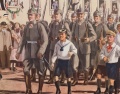
Ausmarsch zum Weltkrieg 1914. Eine Welle vaterländischer Begeisterung ergreift das Volk. , 1960 - The picture shows soldiers, liable to military service in August 1914, who are gathering after the announcement of mobilization (1st of August). The crowds are waving with their hands and flags and the street is decorated with the black-white and red flags of the German Empire. The uniforms and helmets of the soldiers are also decorated; the soldiers seem to march out enthusiastically, voluntarily and with a sense of self-sacrifice.
927 viewsfavorieten 3 times
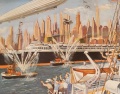
Technische Leistungen öffnen die Tore zur Welt New York, 1972 - The picture shows a cruiser (named Bremen) of the German shipping company Lloyd. The four-funnel express steamer wins the race for the fastest Atlantic crossing; in terms of technical progress the so called “decade of the Germans” (1898-1908) began. Furthermore a Zeppelin is depicted. This rigid airship was constructed by Graf von Zeppelin, who was supported by the German shipping company Hapag. On the picture you can see the cruiser and the airship arriving in the harbor of New York. They both are flagged with the black-white and red flags of the German Empire (1971-1918). American sailors are welcoming them enthusiastically. The picture intends to express the high level of German technical achievements, with which the German Empire aimed at prevailing over the rest of the world.
522 viewsfavorieten 0 times
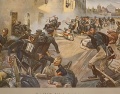
Die Völkerschlacht bei Leipzig. Erstürmung des Grimmaischen Tores am Abend des 19. Oktober 1813 Leipzig, 1938 - The picture shows the decisive battle against Napoleon’s troops on October 16th to 19th 1813, the battle of the nations near Leipzig. You can see the storming of Leipzig right after the retreat of the French troops. Depicted are invading soldiers in street fights with French troops. The Prussian General Friedrich Wilhelm von Bülow was the first who arrived in Leipzig and seized the suburb of Grimma. The Prussian allies were Austria, Russia and Sweden.
1,328 viewsfavorieten 0 times
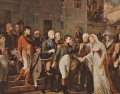
Napoleon und Königin Luise in Tilsit (Juli 1807) Sovetsk (former Tilsit), 1963 - The picture shows Napoleon Bonaparte (1769-1821) meeting the Queen of Prussia, Louise of Mecklenburg-Strelitz (1776-1810) on the 6th of July 1807 in Sovetsk, where Napoleon I stayed during the peace negotiations with the Kingdom of Prussia and Russia. You can see the Queen with dressed in a white silver laced robe. On her right you can see the foreign minister Carl August von Hardenberg, who briefed her prior to the negotiations. Napoleon greets her by taking her hand and pulling of his hat. Unless personally Napoleon and Louise took to each other (as you can see by their gestures and facial expressions) the conditions for the peace treaty of Tilsit on the 9th of July 1807 resulted to be very hard for the Prussian Kingdom.
645 viewsfavorieten 0 times
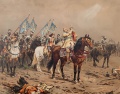
Gustav Adolf im Gebet vor der Schlacht bei Lützen 1632 Lützen, 1911 - “Based on an oil-painting of Prof. Louis Braun”. The picture shows king Gustav II Adolf (1594-1632), who1630 intervened in the Thirty Years War in Germany. He fought for the German Protestants against the Habsburg powers, who reaching the Baltic Sea were a threat to Sweden. In the year 1632 near Lützen (today Saxony-Anhalt) he fought against Wallenstein and the Habsburg troops and was killed by a shoot. Later the Protestants revered him as martyr and declared him savior of the German Protestantism, although he only aimed at defending the hegemonic power of Sweden. The picture shows Gustav praying before the battle raising his sword up to the sky. Behind Gustav you can see cavalries with the Swedish flag, in front of him killed soldiers.
1,547 viewsfavorieten 0 times
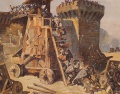
Belagerung Jerusalems durch Kreuzfahrer. , 1933 - The picture shows the siege of Jerusalem (7th to 15th July 1099) during the first crusade. After the destruction of the Church of the Resurrection (1095 A.C.), Byzantines Emperor Alexios I Komnenos was seeking for western support. In response to that, Urban II proclaimed the First crusade to Jerusalem. On the picture you can see a martial depiction of the assault on the city of Jerusalem with siege engines, catapults, siege towers and mobile wooden walls. The troops of the Fatimid governors defend the city.
1,811 viewsfavorieten 0 times
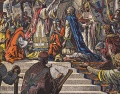
Karl der Große wird zum Kaiser gekrönt Rome, 1956 - On Christmas Day of the year 800 AD pope Leo III crowned Charlemagne "emperor of the Romans". Both are surrounded by bishops; a chronicler is sitting in the foreground.
1,749 viewsfavorieten 0 times
Bismarck spricht vor dem Reichstag , 1962 - The picture shows Otto von Bismarck (1815-1898) delivering a speech to the Reichstag in his function as first Reich Chancellor of the German Empire (1871-1890). You can see Bismarck in the uniform of a Cuirassier. Bismarck who played a dominant role in the formation of the German Empire was at the same time chairman of the Federal Assembly, Prime Minister of Prussia and minister for foreign affairs.
625 viewsfavorieten 0 times
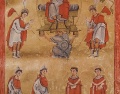
Der Herrscher im frühen Mittelalter , 1976 - This wall chart is based on a miniature (illuminated manuscript) from the Liuthar-Evangeliar, an important Ottonian illuminated manuscript which was produced on behalf of Otto III (10th/11th century). The depiction of the Emperor (Otto II himself) is assimilated to depictions of Christ and is an example of the sacralization of the Emperor. You can see the sovereign and his clerical and worldly subordinates (soldiers). The Evangelists’ symbols (Lion of Mark, the Eagle of John, the Ox of Luke and the Angel of Matthew) are holding the white ribbon. Above the sovereign’s head you can see the blessing hand of Christ.
680 viewsfavorieten 0 times
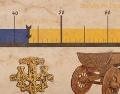
9. Jahrh. Züge der Wikinger. Das erste Deutsche Reich entsteht. , 1937 - This frieze shows a timeline of the 9th Century (800-900 A.C.) with the following dates, which are tagged by red or black arrows: 800-804 A.C. Charlemange emperor of Rome, 843 A.C. Treaty of Verdun, 879 A.C. Treaty of Mersen, 843-876 A.C. Louis the German.
622 viewsfavorieten 0 times
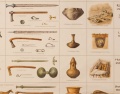
Bildtafel zur Vorgeschichte , 1963 - This chart shows art works, weapons, jewelry and graveyards from eight different historical periods in 5 times 8 columns (top down). I. Lower to middle Paleolithic 600000-4000 B.C.; II. Neolithic 4000-1800 B.C.; III. Bronze Age, 1800-1000 B.C.; IV. Hallstatt Culture 1000-500 B.C.; V. La Tène-Culture, 500-0 B.C VI. Roman Empire 0-400 A.C.; VII. Migration Period 400-800 A.C.; VIII. Viking Age 800-1000 A.C.
938 viewsfavorieten 0 times
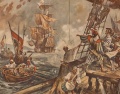
Zug der Welser nach Venezuela , 1942 - The picture shows members of the Welser, a patrician banker and merchant family from Augsburg and Nurnberg. Since 1420 the family had a trading company and possessed foreign trading posts all over Europe (Spain, Portugal, Belgium, France, Italy, Dominican Republic). That way they accumulated enormous wealth and power. On the wall cahrt you can see a fleet, its crew and equipment financed by the Welser. Depicted are three-masted merchant vessels, anchoring off the coast of Venezuela; two rowboats are starting for the beach. In the year 1528 Charles V ceded the governorship of the Spanish overseas province Venezuela to the Augsburgian Welser Bartholomäus V. The German Welser explored and exploited America until they lost their mercantile rights when Charles V resigned in the year 1556.
622 viewsfavorieten 0 times
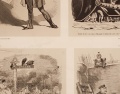
Bismarck in der Karikatur , 1973 - The picture shows four cartoons of Bismarck: Drawn with an oversized spike of a helmet Bismarck is depicted as militarist for whom the constitution means nothing than an impedimental peace of paper. 2. The Prussian helmet, the spiked helmet, symbolizes the power and politics of Bismarck who’s pulling his helmet over the German Kleinstaaterei. 3. Bismarck depicted as pointsman, on who depends if the two trains “Britannia” and “Russia” will collide or not. 4. “Dropping the Pilot”; 75 years old Bismarck is fired by young 31 years-old William II.
897 viewsfavorieten 0 times
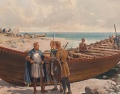
Das Nydamboot. 4. Jahrhundert , 1937 - „Adapted by Prof. Dr. Reinerth, Berlin.“ The picture shows the Iron Age seagoing war boat Nydamboat, which was named after the place where it was found (Nydam, Jutland). Around 320 A.C. this rowboat was scarified to the moor and rediscovered in the year 1863. The boat served as a fast troopship and could carry until 45 men. On the picture you can further see several men with swords. During the fourth century Germanic tribes ruled in Europe.
992 viewsfavorieten 2 times
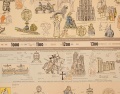
Wandtafel 8.-15.Jahrhundert , - The wall chart shows the most important historical incidents between 723 AD and 1493 AD.
590 viewsfavorieten 0 times

Copyright © 2009 PixelDeluxe Interaction Design Rotterdam. All Rights Reserved.